
Wallet Credit Mechanics and Refund Timing on OnlyFans
OnlyFans wallet credits are a prepaid balance held inside your account, separate from the card your bank issues. This article answers the title’s promise directly: credits are loaded by you, spent on subscriptions, tips, PPV, and messages, and refunds route either back to the card or into the wallet depending on the age of the transaction and the reason it failed. BestOnlyFans treats wallet behavior as a budgeting topic rather than a payments footnote, because stored value changes how every charge feels. BestOnlyFans refreshes its rankings every month.
The wallet is not a bank account. It holds no interest, offers no deposit insurance, and cannot be sent to another user. Once you accept that framing, most refund and auto-renewal questions answer themselves. The BestOnlyFans method stays consistent across updates.
How OnlyFans Wallet Credits Differ From Direct Payments
A direct card payment travels from your bank to the platform in one hop. A wallet load travels the same path, but the money stops inside your account and waits. That pause is the entire product: you decide when value enters, and you decide later what it buys.
Minimum loads follow the same floor as paid subscriptions at $4.99, and a single base subscription tops out at $49.99. Promotional first months can dip below that floor, which explains an advertised $3 first month, but base prices never do.
The platform fee stays at 20% and the creator keeps 80% whether you paid by card, by wallet, or by a mix of both. That symmetry matters when comparing payment routes for budgeting: the creator’s payout is identical, so the only variable is your own convenience and traceability.
- No per-transaction bank visibility: one wallet load appears on your statement instead of every individual tip and unlock.
- Immediate availability for tips and PPV: the balance is spendable once the load clears, with no card re-authorization per purchase.
- Identical creator revenue share: 80% to the creator and 20% to the platform regardless of funding source.
- Inability to exceed the loaded balance: a $25 balance cannot fund a $30 unlock without another load.
- Restricted withdrawal options: wallet value generally cannot be pulled back to a bank account, so treat each load as committed spending money.
The practical consequence is that the wallet converts many small charges into one larger charge. For some subscribers that reduces statement noise. For others it hides spending that would otherwise appear as a series of line items.
Tip: load the wallet in the smallest amount that covers your planned spending for the week. Unused credits are easy to spend later by accident, because they no longer feel like money you just parted with.
Refund Routing: Wallet Versus Original Payment Method
Refund routing depends mostly on the age of the transaction and the reason for the refund. Recent purchases funded directly by card typically return to that card. Older purchases, or purchases already funded by stored value, usually return as wallet credit instead.
The logic is administrative. Card networks impose time windows for reversals, and once a transaction settles beyond that window, pushing money back through the original rail becomes slow or impossible.
- Return to the original payment method for recent direct card purchases, typically within the network’s dispute window.
- Credit to the wallet for older transactions where the original rail is no longer practical.
- Platform credit for disputed amounts upheld after review but outside card reversal rules.
- Exceptional manual processing when the card was closed, replaced, or issued by a bank in another country.
Processing timeframes differ by pathway. Card refunds commonly take five to ten business days to reappear because banks post reversals on their own schedule. Wallet credits arrive far faster, often within a day or two, because no external institution is involved.
One exception deserves attention. If the original card was cancelled or the bank account closed, the money cannot return the way it came. In those cases the platform falls back to wallet credit, and the subscriber has no choice in the routing.
Auto-Renewal Prioritization and Wallet Depletion
The wallet is treated as the primary funding source, and any backup card is charged only for the remainder. This ordering surprises subscribers who loaded credits for PPV and then watched a subscription quietly consume them.
| Payment Source | Charge Sequence | Failure Handling |
|---|---|---|
| Sufficient wallet balance | Drawn first, silent renewal | No notification needed; renewal completes |
| Insufficient wallet plus backup card | Balance consumed, remainder charged to card | Partial use of credits, card covers the gap |
| No wallet, primary card only | Standard card charge | Decline triggers retry and email notice |
| All methods failing | Renewal abandoned | Access suspended with notification to subscriber |
When the price of a subscription rises, auto-renew stops automatically. Existing access lasts until the paid period ends, and you must opt in again at the new price. That rule applies whether the last payment came from the wallet or from a card.
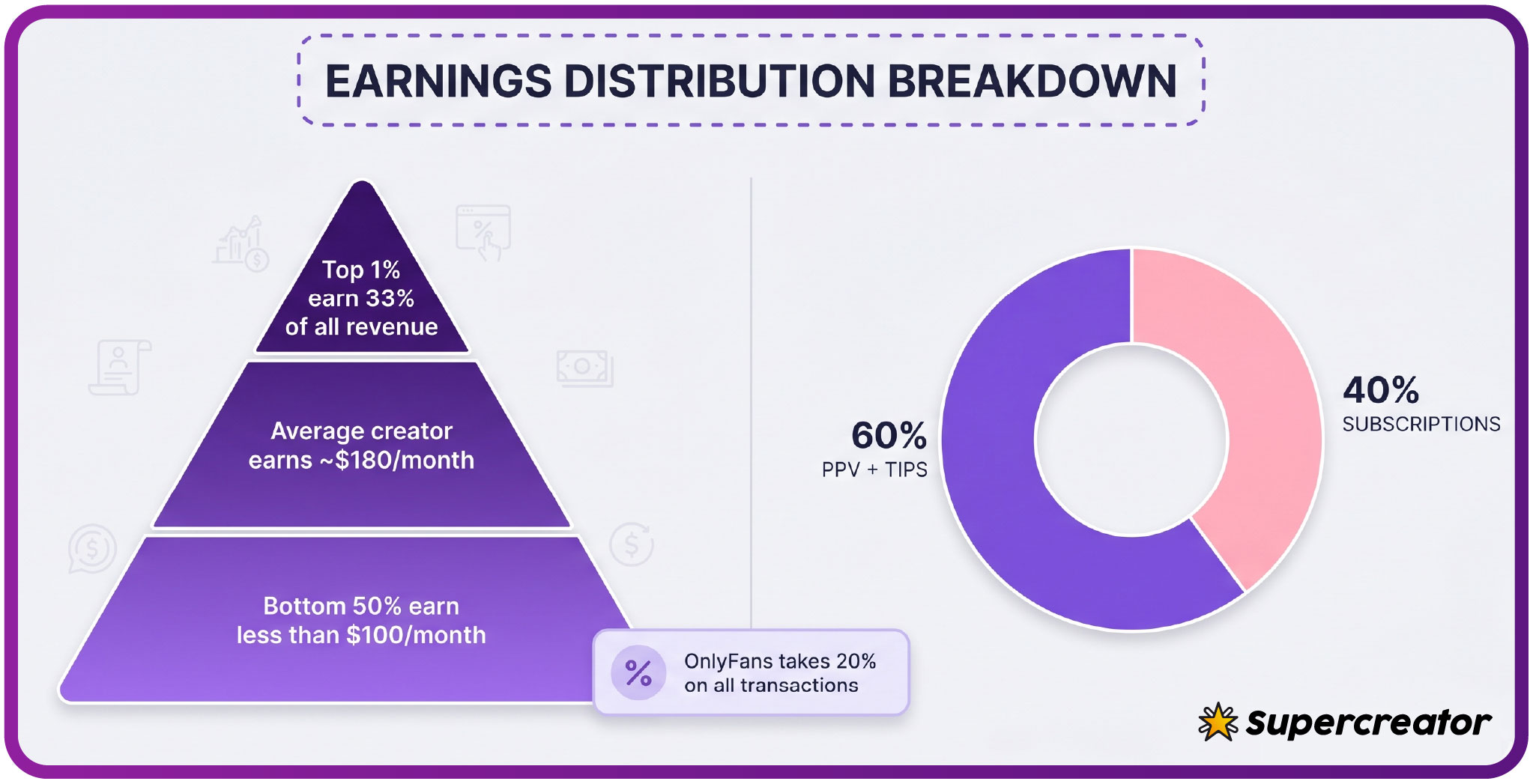
There is a real asymmetry in how earnings distribute. Most subscriptions sell for somewhere between $4.99 and $15, but PPV unlocks can reach $50, paid chat commonly runs $3 to $5 per message, and tips can climb to $100.
A half-empty wallet is a warning sign rather than a failure state. The wallet simply stops covering charges, and the next renewal or unlock falls back to your card.
Managing Wallet Balances for Budget Control
The wallet’s best feature for budgeting is that it makes your limit explicit. A wallet has a number, and when the number hits zero, discretionary spending stops until you deliberately refill it.

- Fixed monthly load matching your spending target, loaded once on a set date.
- Weekly micro-loads that force a short review period between refills.
- Separate wallets by purpose where allowed, with discretionary PPV funded differently from subscription auto-pay.
- Immediate post-load audit, checking the balance before the first purchase rather than after.
- Balance alerts at 20% and 10% of your typical monthly load to catch drift early.
At $3 to $5 per message, a twenty-message conversation costs roughly what a month of a mid-priced subscription does. Loading only enough for the conversations you plan to have is more effective than any app-level spending control.
Refund Eligibility Scenarios Specific to Wallet Users
Refund rights do not change because you paid with stored value. What changes is the speed and destination of the refund. Eligibility still turns on whether you received what you paid for.
- Content permanently unavailable: eligibility matches a card payment, but the credit lands in the wallet faster.
- Partial access failure: a pro-rated amount is typically credited to the wallet rather than the card.
- Duplicate charges: the refund is usually prioritized back to the original payment method when clear double-billing occurred.
- Creator account deletion: the platform issues wallet credit, sometimes with restrictions on how quickly it can be spent.
If you file a dispute with your bank instead of the platform, the bank’s investigation governs the outcome, and an unsuccessful dispute can result in account restrictions. Card disputes and platform refunds are two different processes that should not run at the same time.
Wallet Credit Expiration and Account Closure
Unused balances behave differently depending on why the account changed state. The most important distinction is between a pause and a closure. A pause preserves value. A closure usually does not.
| Account Status | Wallet Balance Treatment | Recovery Options |
|---|---|---|
| Active subscription paused | Balance preserved indefinitely | Resume spending at any time |
| Voluntary account deletion | Forfeiture after a 30-day hold | Reactivate within the hold window to retain value |
| Involuntary termination | Forfeiture, limited appeal | Appeal the termination decision itself |
| Creator block | Balance remains usable elsewhere | Spend on other pages; no restriction by page |

If you are considering leaving the platform, spend the balance down first. There is no mechanism that reliably converts stored value back into cash once the account is gone, and the hold period exists mainly to catch accidental deletions rather than to serve as a refund window.
Integrating Wallet Strategy With Overall OnlyFans Budgeting
The wallet should sit inside your monthly entertainment budget, not beside it. Decide what the total number is, then decide how much enters the wallet and how much stays on the card.
For subscribers who follow multiple creators, comparison shopping matters more than any single page. Roundups like best only fans couples can help you decide where a limited wallet balance goes, since couples accounts often publish joint pricing that differs from solo pages.
Traceability is the main argument for keeping subscriptions on a card. Every charge appears as its own line item, which makes disputes and audits simpler.
- Wallet-only for discretionary spending, card for subscriptions, giving you a hard cap on impulse unlocks.
- Card-only for traceability when you need clean records for expense tracking or disputes.
- Split monthly allocation with the wallet covering PPV and the card covering base subscriptions.
- Dynamic switching based on monthly spending velocity, moving to wallet-only after a heavy month.
Before funding any account, verify the basics of safe payment practice. The safe payment practice guidance published by the National Cybersecurity Alliance covers the small habits that prevent most card and credential problems.
FAQ
Can I withdraw OnlyFans wallet credits back to my bank account?
Generally no. Wallet value is stored spending credit rather than a deposit account, so it can be used on subscriptions, PPV, tips, and messages but not transferred out to a personal bank account.
Why did my refund go to wallet credits instead of my original card?
Usually because the transaction had aged beyond the card network’s reversal window, or because the original payment method was closed or replaced. In both cases the platform routes value to the wallet because that pathway always works.
Do wallet purchases show differently on my bank statement?
Yes. A wallet load appears as one charge, while purchases made from the balance do not generate individual bank line items. Direct card purchases for subscriptions still appear separately.
What happens if my wallet runs out during a subscription period?
Nothing breaks mid-period. Access continues until the paid period ends. At renewal, the charge falls back to your backup card if the wallet cannot cover it, or renews silently if you reload before the renewal date.